
Does the Proposed Emerald Coast Motor Club Have a Location Problem?
Nearly four times the acreage of Tampa’s Motor Enclave, in a county with approximately 94% fewer residents and 92% fewer employer establishments.
DEFUNIAK SPRINGS, Fla.— The developer of Tampa’s Motor Enclave has a blunt rule for anyone trying to build a profitable motorsports club: “You can’t be in a rural area.” Florida Law says Walton County is a rural community. Yet that is where developers propose the much larger Emerald Coast Motor Club. Brad Oleshansky, who built Michigan’s M1 Concourse before Tampa and helped pioneer the U.S. motorsports club model, said pre-sales of luxury garages helped finance construction, but corporate events is what makes the business work. Those corporate customers need to be nearby. Can ECMC find enough buyers and event clients in a drastically smaller market to pay for the project and sustain it?
Oleshansky’s Tampa club occupies 200 acres with a 1.72-mile circuit and more than 300 private garages. ECMC proposes 751 acres and a 3.2-mile course near rural DeFuniak Springs. An ECMC traffic study lists 330 car condos of 1,600 square feet each, along with other garages, storage, villas, and amenities. Both clubs combine track access, garage ownership, memberships, and events. ECMC would have to make that same formula work across a much larger site and in a much smaller local market.
Those differences raise a question prospective investors should be asking: Is there enough nearby demand to support the proposed project? A larger development does not automatically produce a larger customer base. Before committing capital, investors would need evidence that ECMC can attract enough garage buyers, members and corporate clients in a market substantially smaller than Tampa’s.
Tampa Was Selected Through Market Research
In a July 2026 Cars & Culture interview, Oleshansky described building five customer profiles from his first club in Michigan, then mapping wealth, growth, and vehicle registrations across the country. Tampa stood out. The decisive factor, he said, was “location, location, location.” He visited several cities and evaluated land availability, approvals, and how close a site was to the people who would use it. He had never been to Tampa before the research pointed him there.
He bought land beside a freeway and Tampa Executive Airport, a short trip from the city. The nearby airport and highway were advantages for access and existing background noise. His typical garage buyer, he said, was often a professional, executive, or business owner around age 55 or 60 seeking a social community. He estimated that 80% of garage buyers at his two clubs did not own an extra car when they purchased. For many, the attraction was a place “20 minutes away” that let them visit briefly and still get home for dinner.
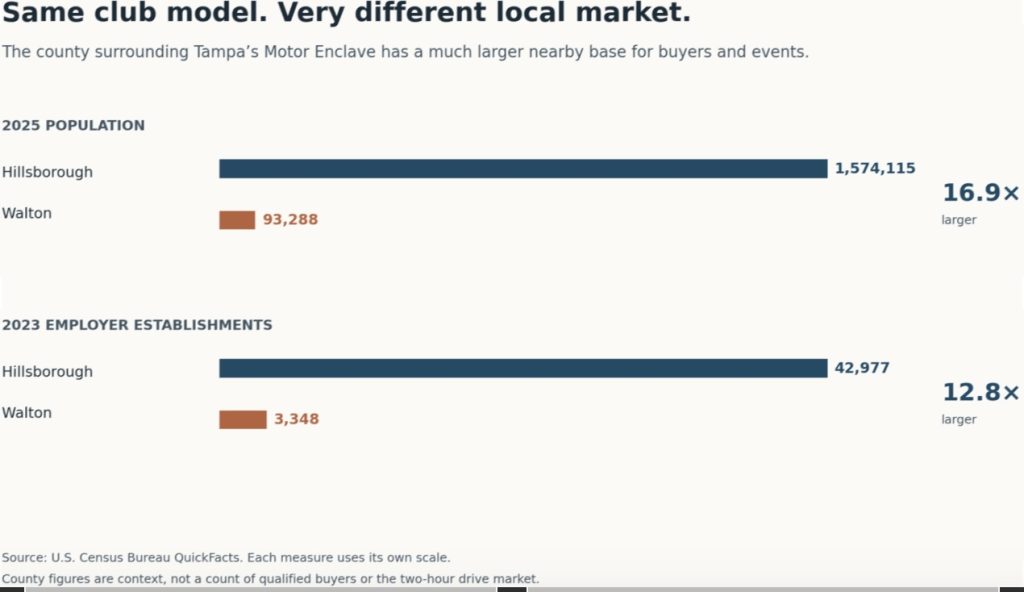
That customer is harder to win if the club is a long drive from work or home. Walton County certainly has affluent residents and visitors, and ECMC points to South Walton beaches about 30 minutes from its site. But a beach visitor is not automatically a year-round garage buyer or a nearby corporate event planner. The U.S. Census Bureau estimates 93,288 Walton County residents in 2025, compared with 1,574,115 in Hillsborough County, where Tampa’s club sits — nearly 17 times as many. In 2023, Hillsborough had 42,977 employer establishments to Walton’s 3,348, nearly 13 times as many. Neither county boundary captures every prospective customer within driving distance, but the local bases are starkly different.
Events Are the Second Test
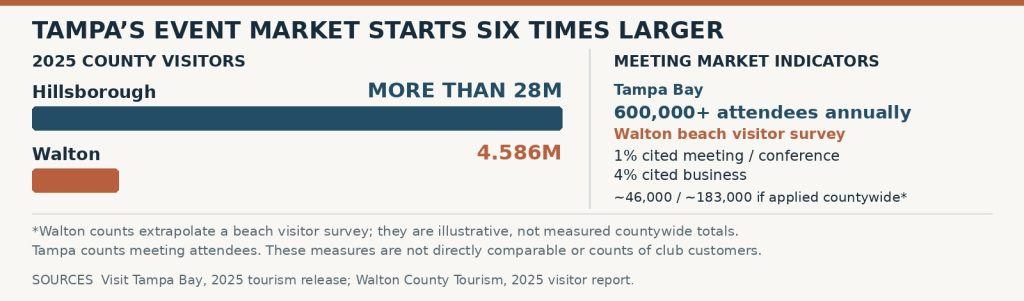
“You’ve got to be close to where the corporate clients are because that’s the business end of it,” Oleshansky said. Garage buyers helped finance his construction; events supply the profit. Tampa’s large surrounding market gives it a head start: Hillsborough County drew more than 28 million visitors in 2025, and Visit Tampa Bay says meetings and conventions bring more than 600,000 attendees annually.
In comparison, Walton County drew 4.586 million visitors in 2025 — less than one-sixth of Hillsborough’s total. In a beach visitor survey, 4% cited business and 1% a meeting or conference. Applied to all county visitors, those shares suggest about 183,000 business-related and 46,000 meeting-related visits. ECMC would have to build an event business from a much smaller nearby visitor and corporate base.
What Tampa’s Garage Financing Implies
Oleshansky told the interviewer that roughly $130 million of an approximately $150 million Tampa project came from garage presales and installment payments — about 87% of its reported cost. Nearly all the roughly 300 garages had been sold by opening. He said unexpectedly strong sales helped absorb cost overruns that nearly sank the project. That account describes money collected over time, not $130 million in cash before the first shovel hit the ground.
No public construction budget or garage asking prices for ECMC have been announced. ECMC founder and developer Steve Denton has said his team commissioned a financial feasibility study and investment memorandum and aligned 12 investors. ECMC’s claim of nearly $500 million in eventual property value impact is not a construction-cost estimate. To estimate what ECMC’s car condos might have to sell for under Tampa’s financing model, this analysis applies Tampa’s reported 86.7% garage-funded share to three illustrative ECMC full-build costs. It assumes 5% selling costs and divides the required gross receipts among all 330 proposed car condos:
| Illustrative ECMC build cost | Required net garage receipts | Average garage price if 330 sell |
| $200 million | $173 million | $553,000 |
| $300 million | $260 million | $829,000 |
| $358 million | $310 million | $990,000 |
The $358 million case is our earlier planning allowance for track work, infrastructure, proposed nonresidential buildings, soft costs, and contingency. It is not a bid or an ECMC forecast, and it omits land, financing and the proposed residential units. If only 250 condos sold in that case, the required average purchase price would rise to about $1.31 million per luxury garage. Denton has described the proposed garages in a recent public interview as shells that owners would finish at their own expense, adding to a buyer’s total cost. Other equity, loans, memberships, and real estate sales could reduce reliance on condo sales; phasing could also lower the amount needed at the outset. The county filed plan places only some car-condos in its first phase, and does not give a phase-by-phase sales target.
Oleshansky also warned that some competitors are “a very wealthy person who wants to own a racetrack” because they race and favor the biggest possible circuit. Steve and Paul Denton are partial owners in a race team and have competed together in endurance racing, and ECMC proposes a longer circuit than Tampa’s. That resemblance does not establish anyone’s motives or business judgment. It sharpens the commercial question: Has the size of this project been matched to the buyers and event customers close enough to use it often?
The same garage-and-events model that succeeded in Tampa faces a severe location test in Walton County. Has founder and developer Steve Denton’s passion for racing led him to underweight the market that must finance and sustain his much larger project? This analysis cannot determine his motives or predict a failure. It does show that a Tampa-like financing approach could require hundreds of buyers at prices approaching $1 million for an unfinished garage, while the event business draws corporate customers to rural Walton County. County approval would not guarantee those sales or even a groundbreaking. If financing stalled after approval, the promised jobs and tax gains might never arrive; if construction began and stalled, neighbors could be left beside an unfinished project. The question for Walton County is whether this location can support the business long after the excitement of building a racetrack wears off.
The location question is also an investment question. If proximity to customers helped make Tampa’s model work, what evidence shows that a much larger project can succeed in Walton County’s much smaller market?
Sources and Calculation Notes
Motor Enclave site, track and garages
Economic Club of Tampa biography of Oleshansky and M1 Concourse
U.S. Census Bureau, Walton County QuickFacts
U.S. Census Bureau, Hillsborough County QuickFacts
Walton County Tourism 2025 annual visitor survey, p. 48
Visit Tampa Bay 2025 visitors and meetings figures
MRC Motorsports account of ECMC feasibility and investors
Cushman & Wakefield, 2026 Americas Industrial Construction Cost Guide
Florida Department of Transportation Construction Cost Index, June 2026
ECMC Traffic Study V1, p. 10, and Master Plan X-105, supplied application records
Calculation: cost × (130 ÷ 150) ÷ 0.95 ÷ 330. The $358 million allowance used 528,000 square feet of car condos at $175 per square foot, 434,800 square feet of other storage/service space at $130, 75,000 square feet of paddock/club space at $350, $55 million for track/site work, $35 million for infrastructure, plus 15% soft costs and 20% contingency on hard costs. Cushman & Wakefield’s industrial-building figures inform the building allowances, but its warehouses are not luxury garages or clubhouses. FDOT’s index describes Florida transportation bid trends, not a racetrack quote. The project-specific rates and $90 million site/infrastructure allowance are our unverified assumptions, not contractor quotes.
Disclaimer: This post is intended for informational and public awareness purposes only. The content reflects the analysis and interpretation of publicly available materials, public records, and quotes provided by Brad Oleshansky’s July 2026 Cars & Culture Podcast interview. All information cited is accurate to the best of our knowledge. This post does not make any claims of misconduct or liability and is protected opinion under applicable law.