
Emerald Coast Motor Club Economic Feasibility: Does the Market Support a 600-Member Private Racetrack?
ECMC is backed by racers and automotive enthusiasts pursuing a motorsports-country-club vision. But comparable Florida clubs have deliberately located beside much larger, wealthier markets — and the consultant that prepared ECMC’s feasibility analysis is led by an ECMC co-founder and investor.
DEFUNIAK SPRINGS, Fla. — Emerald Coast Motor Club is proposing a sprawling private motorsports country club in Walton County with a business model its own traffic study says could ultimately serve about 600 members. But a comparison with Florida’s other private motorsports clubs reveals a striking difference: ECMC would be attempting that model from a regional customer base dramatically smaller than virtually every comparable project in the state.
The people behind ECMC are not casual observers of motorsports. Steve Denton has competed under the Denton Carden Racing name, and his brother, Paul Denton, also appears on competitive race entry lists. Motorsport is clearly part of the founders’ personal world.
There is nothing wrong with enthusiasts wanting to build the kind of facility they themselves would enjoy.
The question is whether the dream matches the market.
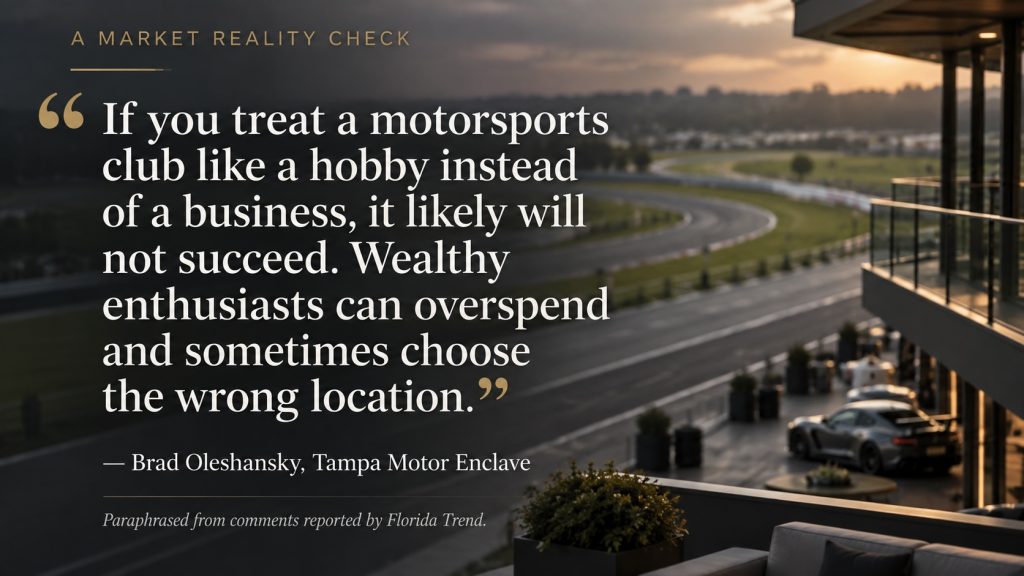
A conservative comparison places ECMC’s core regional market at about 1.25 million people, drawing primarily from the Pensacola, Crestview-Fort Walton Beach-Destin, Panama City and Dothan metropolitan areas. Pensacola alone has about 545,000 residents and Crestview-Fort Walton Beach-Destin about 315,000.
Compare that with Circuit Florida in Auburndale, an operating motorsports country club and residential community positioned just off Interstate 4 between Tampa and Orlando. Tampa, Orlando and Lakeland together contain about 7.25 million residents — nearly six times ECMC’s core regional market. Circuit Florida itself promotes its proximity to both Tampa and Orlando as a central advantage of the development.
The pattern repeats elsewhere.
The Motor Enclave in Tampa was deliberately placed in a major metropolitan market. Precision Drive Club and The Concours Club operate inside the Miami-Fort Lauderdale-West Palm Beach metro, population about 6.39 million. P1 Motor Club in St. Lucie County markets its location specifically as being between Palm Beach and Orlando and supplements its private club with residences, outside events and more than 400,000 square feet of motorsports-related commercial and industrial space.
Those markets are not simply larger. They contain enormous concentrations of wealth. Henley & Partners counted approximately 38,800 millionaires in Miami and another 11,500 in West Palm Beach, including 78 West Palm Beach residents with at least $100 million in investable wealth.
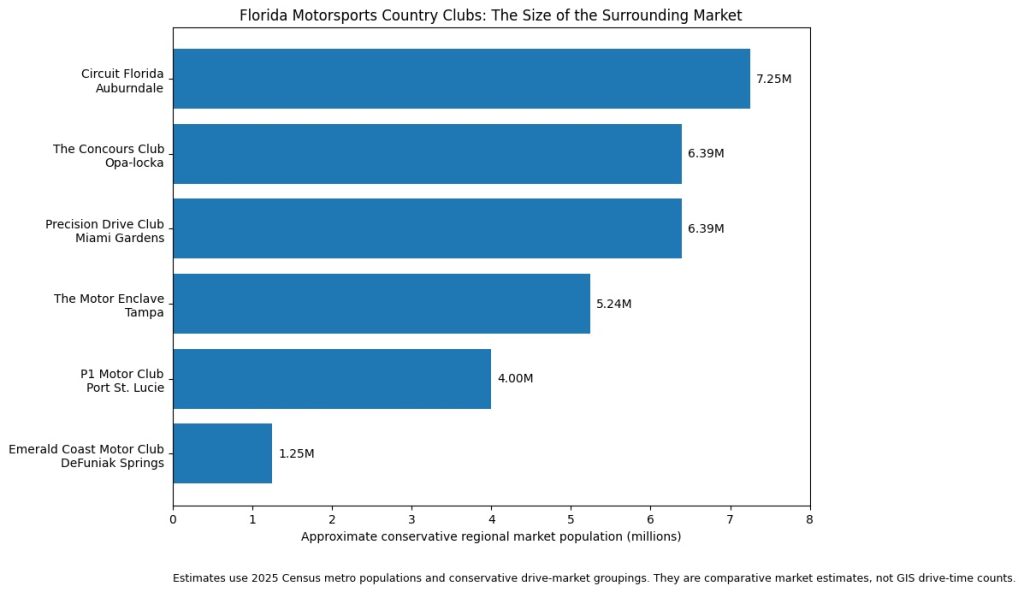
Perhaps the clearest contrast comes from Motor Enclave founder Brad Oleshansky.
Before developing his Tampa project, Oleshansky had already developed a similar automotive community in Michigan. He told Spectrum News that he had never even been to Tampa when a computer model examining the market selected it.
“I chose Tampa based on data — I had never been to Tampa in my life.”
His warning about motorsports developments is even more pointed.
“If you run it as a hobby, it’s not going to work. I run it as a business.”
Oleshansky told Florida Trend that wealthy enthusiasts can overspend or select poor locations when attempting to develop tracks. His own Motor Enclave does not depend primarily on racing enthusiasts or track dues; he says its large event operation and garage-condominium business are central to its economics.
ECMC has commissioned professional feasibility work of its own — but there is an important distinction.
Mücke Roth & Company says it spent three months developing ECMC’s market assessment, business plan, investment memorandum and financial feasibility analysis, work Steve Denton said helped align all 12 investors.
But the firm’s own biography for managing partner Michael Mücke says he is also an investor in and co-founder of Emerald Coast Motor Club. Mücke leads the firm’s motorsports advisory work at its senior-most level.
That does not establish that the feasibility analysis is inaccurate. It does mean the analysis should not be confused with validation from a wholly independent third party with no financial stake in the project.
And it makes the underlying assumptions particularly important.
What does ECMC’s market study show that supports a roughly 600-member private motorsports club in DeFuniak Springs when comparable Florida projects have deliberately located themselves beside markets three, four, five and nearly six times larger?
Walton County unquestionably has wealth, tourism and affluent second-home owners. But this business requires something much narrower than general affluence: people with substantial discretionary wealth, high-performance or collectible cars, an interest in track driving, the willingness to pay private-club costs and enough proximity to use the facility repeatedly.
Florida’s existing developers appear to understand that equation.
Circuit Florida planted itself between Tampa and Orlando. Motor Enclave’s founder says data led him to Tampa. P1 positioned itself between Palm Beach and Orlando. Miami’s private clubs sit inside one of the wealthiest metropolitan markets in the country.
ECMC chose DeFuniak Springs.
That does not prove the project cannot succeed.
But before Walton County accepts claims about jobs, tax revenue and economic benefit, there is a reasonable question worth answering:
Is Emerald Coast Motor Club a business opportunity that found the right market — or a motorsports dream trying to make the market fit the idea?
Disclaimer
This post is intended for informational and public awareness purposes only. The content reflects the analysis and interpretation of publicly available materials, public records, and quotes provided by WCEDA. All information cited is accurate to the best of our knowledge. This post does not make any claims of misconduct or liability and is protected opinion under applicable law.;