Why ECMC Needs a Predictive Noise Study Before Conceptual Approval
Walton County should require a predictive noise study before granting conceptual approval to Emerald Coast Motor Club (ECMC), the approximately 755-acre motorsports development proposed in DeFuniak Springs’ Alaqua and Woodlawn neighborhoods.
The county is considering the project’s uses, scale and general layout. Whether those uses can operate compatibly with surrounding homes is a central question. Residents want evidence showing what they would hear and what protection would be required.
The applicant says detailed design must come first
At the September Technical Review Committee hearing, applicant’s attorney Stephen Tatum said noise analysis must wait until detailed designs establish building and wall locations. Preparing those designs before conceptual approval, he argued, would cost “millions and millions and millions of dollars.” [1]
The applicant says the noise study must wait for detailed designs costing millions. Our research shows the study can be done now, using the conceptual plan and defined operating assumptions.
We spoke directly with four U.S. acoustical consulting firms experienced with motorsports facilities. Those conversations indicated approximately $25,000–$30,000 for an ECMC predictive study, depending on scope. These are preliminary estimates from direct conversations, rather than a fixed project bid. [2]
A study can use the proposed track layout, terrain, vehicle types, simultaneous vehicle counts, and nearby home locations to predict sound. It can then test different barriers, setbacks, and operating restrictions.
That work helps determine what the detailed design must accomplish. Final engineering should carry out the protections identified through the study.
ECMC’s existing study does not predict racetrack noise
ECMC’s May 13, 2026 Site Noise Measurement Study documents existing background sounds, including traffic, insects, wind and aircraft. It does not predict operating racetrack noise at neighboring homes. [3]
The applicant’s Initial Acoustical Planning Strategies discusses buildings, berms and walls as potential protection. But statements about sound reduction do not tell residents what sound level would remain at their homes. [4]
The submitted PUD Regulations place a detailed acoustic analysis at the later Detailed PUD stage. That commitment to a future study leaves the central question unanswered during conceptual review: Can the proposed operations be made compatible with the surrounding homes, and under what conditions? [5]
The proposed scale makes early analysis essential
The 2024 conditional-use order covered approximately 651 acres. The supplied conceptual application documents describe approximately 755 acres. Their building schedule includes: [5–6]
| Proposed use | Building area |
| Car condos | 528,000 sq. ft. |
| Car storage and track services | 308,000 sq. ft. |
| Public RV storage | 50,000 sq. ft. |
| Car workshops | 20,000 sq. ft. |
| Combined | 906,000 sq. ft. |
Together, these uses account for approximately 87% of the stated 1,045,800 square feet of nonresidential building area. This percentage describes building space, not acreage. [5]
The project narrative anticipates 15–30 cars on the 3.5-mile track together during typical weekday sessions lasting 30–45 minutes. Describing the vehicles as “street-legal” does not establish their sound at neighboring homes under track conditions. [7]
Other communities have evaluated proposed track concepts
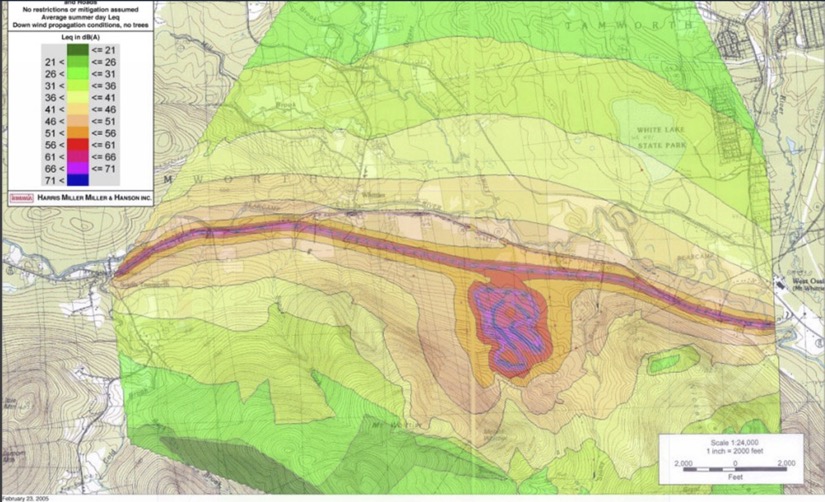
Club Motorsports, New Hampshire: HMMH modeled anticipated noise using vehicle measurements from another track. It evaluated busy and average days and recommended property-line sound limits that the town adopted. [8]
Cooper Park/SPARC, Ohio: HMMH evaluated a proposed racetrack, recommended noise barriers and helped develop a monitoring agreement. The analysis informed the project’s approval. [9]
Vancouver Island Motorsport Circuit, British Columbia: North Cowichan commissioned Navcon to independently review acoustic studies associated with the Tilke-designed circuit and its proposed expansion. Navcon challenged the developer’s conclusions. Our conversation with the firm indicated approximately $18,000 for its review work—a different assignment from a new predictive study. [2, 10]
Orlando Motorsports Park, Florida: Noise was scrutinized during review of the proposed facility. Osceola County’s Development Review Committee recommended denying its noise-variance request. [11]
These examples show that acoustic analysis can inform decisions about proposed facilities. Each jurisdiction’s approval process differs; they are not all formal conceptual PUD proceedings.
Make protection binding before conceptual approval
Residents are asking Walton County to require an independently reviewed predictive study now and use its findings to establish:
- Necessary track setbacks, barriers and space reserved for mitigation.
- Permitted vehicle types, simultaneous vehicle counts and operating hours.
- Clear sound-performance criteria at neighboring homes.
- Monitoring, enforcement and corrective-action requirements.
- Installation of required mitigation before the affected operations begin.
The developer is asking residents to accept assurances that noise will be controlled later. A commitment to submit a future study does not establish which protections will be required or demonstrate that they will work.
If ECMC’s proposed protections can work, a predictive study should demonstrate that before conceptual approval. Final engineering can follow. Binding commitments to protect neighbors should already be established.
Sources
- September 2026 Walton County TRC hearing: Stephen Tatum remarks, transcript supplied by a meeting attendee.
- Residents’ direct conversations with four U.S. acoustical consulting firms experienced with motorsports projects. Cost estimates depend on scope; Navcon’s review fee is separately reported from that conversation.
- Siebein Associates, Site Noise Measurement Study, May 13, 2026, cover letter and report introduction.
- Siebein Acoustic, Initial Acoustical Planning Strategies, June 25, 2026, pp. 1–2.
- ECMC, PUD Regulations, supplied V1, “Maximum Development Intensity & Permitted Uses,” printed p. 5; “Acoustic Analysis,” printed p. 10. Figures describe this submitted version.
- Walton County Zoning Board of Adjustment, Conditional Use Order CU24-000002, hearing October 24, 2024, p. 1.
- ECMC, Project Narrative, supplied V1, printed pp. 18–20.
- HMMH: Club Motorsports Racetrack Noise Analysis.
- HMMH: Cooper Park (SPARC) Noise Analysis.
- The Discourse: Track noise projections “misleading,” independent review finds, September 12, 2019; reporting on North Cowichan’s Navcon reviews.
- WFTV: Kissimmee residents against proposed motorsports park, October 4, 2017.
Disclaimer: This post is intended for informational and public awareness purposes only. The content reflects the analysis and interpretation of publicly available materials, public records, and quotes provided by Brad Oleshansky’s July 2026 Cars & Culture Podcast interview. All information cited is accurate to the best of our knowledge. This post does not make any claims of misconduct or liability and is protected opinion under applicable law.